THEMATIC SESSION #34
Toward Effortless Assistive Intelligence: Closed-Loop Integration of Large Language Models in Next Generation Brain Computer Interfaces and Cognitive Assistive devices
ORGANIZED BY
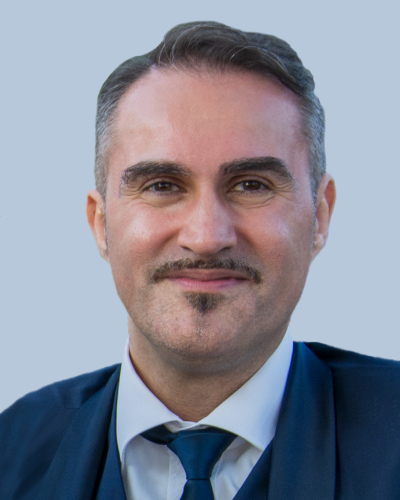 Andrea Monteriu
Andrea Monteriu
Polytechnic University of Marche, Italy
 Karameldeen Omer
Karameldeen Omer
Polytechnic University of Marche, Italy
 Francesco Ferracuti
Francesco Ferracuti
Polytechnic University of Marche, Italy
THEMATIC SESSION DESCRIPTION
This session introduces the paradigm of effortless assistive intelligence—robotic systems that minimize user effort by integrating EEG-driven brain–computer interfaces, vision–language models, and large language models within closed-loop adaptive architectures.
Unlike conventional assistive systems that rely on explicit commands or predefined task pipelines, effortless systems continuously infer user intentions by combining internal neural signals with external environmental perception and semantic reasoning. This fusion enables real-time adaptation, cognitive workload awareness, and personalized assistance across daily-life and clinical environments.
We invite contributions that advance unified frameworks bridging neural decoding, multimodal foundation models, and embodied robotics to create assistive technologies that operate naturally, intuitively, and with minimal cognitive burden. We invite contributions that link neuroscience, AI foundation models, and human-centered design to advance scalable and ethically grounded assistive technologies.
TOPICS
Topics of interest include (but are not limited to):
- Neuroadaptive & Closed-Loop Systems:
- EEG-driven robotic control;
- Cognitive state estimation;
- Adaptive assistance using error-related potentials;
- Human-robot co-adaptation frameworks;
- Neuro-Symbolic & Foundation Model Integration:
- Language model integration in assistive robotics;
- Contextual perception through vision-language models;
- Multimodal alignment (EEG + vision + speech + wearables);
- Cognitive Living & Daily-Life Deployment:
- Assistive robotics in everyday environments;
- Brain-aware smart homes;
- Long-term personalization and adaptation;
- Edge AI for embedded assistive systems.
ABOUT THE ORGANIZERS
Andrea Monteriù received his M.Sc. in Electronic Engineering (2003) and Ph.D. in Artificial Intelligence Systems (2006) from Università Politecnica delle Marche, Italy. He is an Associate Professor of Systems and Control Engineering and Director of the Laboratory of Artificially Intelligent Robotics (LAIR). His research interests primarily include fault diagnosis, fault-tolerant control, nonlinear dynamics and control, periodic and stochastic system control, applied in different fields including aerospace, marine, robotic, and unmanned artificial intelligence systems. He has authored over 250 peer-reviewed publications and currently serves as Chair of the IFAC Technical Committee 7.2 on Marine Systems.
Karameldeen Omer is a Postdoctoral Researcher at the Laboratory of Artificially Intelligent Robotics (LAIR) at Università Politecnica delle Marche and a lecturer at the University of Khartoum, Mechanical and Mechatronics Engineering Department. His research focuses on intelligent autonomous systems, assistive and service robotics, and brain-machine interfacing (BCI). He has expertise in robotic control and technologies and contributed to research institutions in Italy, the Netherlands, and Spain. His work has earned academic recognition for advancing AI-driven assistive robotics to enhance human-robot interaction and quality of life.
Francesco Ferracuti received his Ph.D. degree in automation, information, and management engineering from Università Politecnica delle Marche, Ancona, Italy, in 2014. He is an Associate Professor at the Università Politecnica delle Marche. His research interests include model-based and data-driven fault diagnosis, signal processing, statistical pattern recognition, system identification, and their applications in industry.